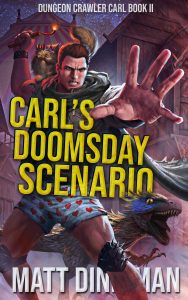
Carl’s Doomsday Scenario by Matt Dinniman (Dungeon Crawler Carl #2)
After reading some crappy boring books, this is a breath of fresh air. Just a guy and his cat having adventures in a dungeon. I wish I could write like this. I mean, yeah, the profound deep heavily written stuff is what has staying power, but above all I just want to be entertaining. People don’t remember what you did, but they will remember how you made them feel. It’s all just fun. Just a guy playing D&D with himself, and he gets a following. He’s got board games and graphic novels coming out. I’m not saying I’m jealous–the guy deserves it. It’s just a shame he doesn’t get more recognition from the literary community. The guy had to write a million words on Royal Road before he got recognized. It shouldn’t have to work like that.
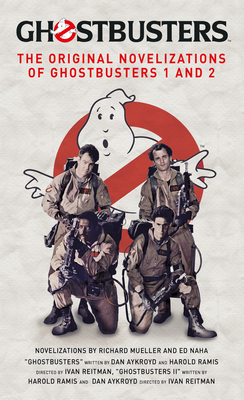
Ghostbusters and Ghostbusters II (the original novelizations) by Richard Mueller and Ed Naha
Surprisingly well-written for a novelization. I was worried that this would be a slog because it looks really thick and it’s two books together, but it goes at a good pace. Good enough that I had no problem reading both back-to-back. Plus, like a good novelization should do, it adds in fun little details that did not make it into the movie, or were just pulled out of the author’s ass to make a word count. Like how Egon is addicted to Baby Ruths, and Venkman used to be a carnival barker who could somehow afford to go to college and get a Ph.D. It’s always nice to see a fresh take on a classic.
Straight by Chuck Tingle
This is the first thing I’ve read from Chuck Tingle, who’s a name prominent in the bookosphere for writing a bunch of “something pounded me in the ass” books. I’m not sure what those are about. I wanted to read something serious from him, and this was about the only thing I could find. It’s fine. It would make a good movie. The idea is sound, and a nice allegory for the persecution of LGBT people. But it needed revision; there were a lot of typos and issues with composition, like the author uses “arial” (a font) when he means “aerial” (airborne). I know he has another longer book out–Camp Damascus–which is, I think, a horror story about a gay conversion camp. But I really have no desire to read it after sampling this.
Writing Tools: 50 Essential Strategies for Every Writer by Roy Peter Clark
(unfinished)
It starts with the nuts and bolts about writing, then scales up from there. Very tiny things like how to structure a sentence, put the most important information at the end, etc. And also a bunch of stuff I already knew–don’t use passive voice, don’t use adverbs, etc. I don’t know why I can’t read a book about writing that’s not about the same thing over and over. Plus, its too much about journalism, not fiction writing. It keeps citing Walter Cronkite, Edward R. Murrow, and Thomas Wolfe. These are not the authors I see on the NYT bestseller lists. I need to know what THOSE people did. How they got published. What did they do that made them chosen?
The Tainted Cup by Robert Jackson Bennett (Shadow of the Leviathan #1)
I love when genres crossover and whenever there’s a murder mystery in fantasy land, I’m there. Because that stuff is hard to write without caving in to “a wizard did it”. You have to not only explain a weird crime, you’ve got to worldbuild. And worldbuild in such a way that the reader is intrigued by the mystery without giving it all away. The crux of the world is that you can affect or mutate living things, like you make a plant so that it covers a doorway and only opens up for people with a certain chemical. You can also mutate people to give them powers like mathematical genius or strength for soldiers. Also there are kaiju to worry about. But the characters in this book are what sell it for me.
There’s sort of a Watson-Holmes thing going on, but it’s definitely not just Sherlock in Narnia. The main character is an investigator for an empire… sort of. He has the ability to remember everything, like a living recorder, or Memory Man. But he’s not the detective. The person he works for is, but she’s such a savant that she gets overwhelmed (kind of like Robert Downey Jr.-Holmes) and stays in her house blindfolded while the investigator does the legwork. Then he comes back and tells her everything he saw, and she figures it out. He’s the observer and she’s the deducer, and it’s such a unique relationship that I haven’t seen before, and it works really well. All the characters are people you want to find out about–they all have flaws and impediments, not strengths disguised as flaws like Poirot or Monk. I will be reading the next in the series for sure.
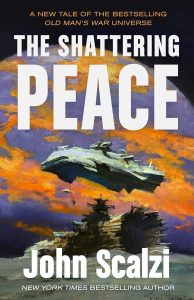
The Shattering Peace by John Scalzi (Old Man’s War #7)
It’s a Scalzi. That’s for sure. I mean, I have nothing new to say about him at this point. This is another book in the Old Man’s War universe, but it’s more of a sequel to Zoe’s Tale. I mean, it’s a standalone like all the OMW books, but readers of Zoe’s Tale will get the most out of this. Like all his books, it’s plot-heavy, but emotion-light. Meant for entertainment, which is all I ever ask of a book.
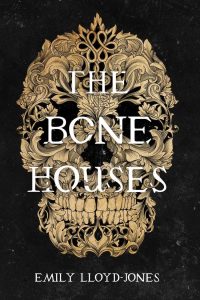
The Bone Houses by Emily Lloyd-Jones
Zombies in a fantasy setting. Who’d have thunk it? Well, the author, I guess. But certainly no one around the main character, as is par for the course in most zombie stories. She’s known about them all her life, but now they’re coming out of the woodwork. It’s fun to see a zombie attack on what would be the equivalent of Kakariko Village.
What surprised me was that there’s a nice sense of humor throughout. It’s not Buffy the Vampire Slayer, as the description claims, but the characters aren’t stolid, stoic, everything’s-grim-and-serious peasants like they’re always portrayed. I always think that the characters in anything dramatic are always too dour. They never joke around with their friends or make sarcastic remarks. Think about how much you try to make your friends laugh. Why do I never see that kind of dialogue in fiction?
The love story is a big part of it though, and I feel that kind of interferes with the main crux of the story, which is essentially a quest. We’ve got character A who needs to get to point B. In this case, the source of the zombies. It’s also very rooted in Welsh mythology, which I don’t know anything about and the language always looks like a cat walking on a keyboard. I also didn’t realize it’s categorized as YA, but I could be fooled into thinking this was for adults. Do I recommend it? Yes, I think I do.