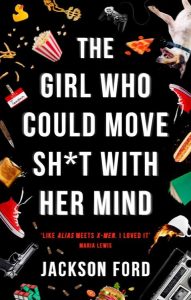
The Girl Who Could Move Sh*t With Her Mind by Jackson Ford
On a Facebook post for my library, they offered a challenge saying “Give me any book and I’ll recommend something based on it.” For a lark, I gave it “I’m Worried About This Black Box of Doom“, since I’d love to find anyone that matches Pargin’s unique style. This book was the response. It did not hit the mark.
The narrative is snarky enough, but it’s not wise or conventionally intelligent or containing hard truths. It’s a basic action chase story about a girl with telekinesis who’s part of a BlackOps team. They’re searching for a killer who may have the same powers as her and the POV flips back and forth between them.
It fulfills the first two requirements of any basic story–the protagonist is established and so is what she wants. But the “who/what is trying to stop her” is nebulous. There seem to be “men in black” agents, but it’s not clear who they are or what they’re capable of or what their end goal is. And also, I thought the good guys worked for a government agency in the first place. I’m not sure who works for who. Are these secret agents? A syndicate? A shadow government? No one knows and there are no answers by the end.
That makes it feel like the stakes are behind a black curtain–I don’t know what’s going to happen if the protagonist fails, therefore it’s hard to care about the consequences of anyone’s actions. No “ooh, what’s going to happen? I must read on.” because I don’t know what could happen. To me, it sounded like going over to the bad guys might have been a better deal for the main character. Whatever she’s involved with now seems to be small potatoes.
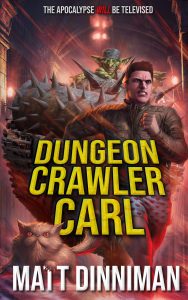
Dungeon Crawler Carl (Dungeon Crawler Carl #1) by Matt Dinniman
It’s an indulgent story with a ridiculous implausible concept and I’m so here for it.
Imagine books like The Hunger Games and The Maze Runner if you take out all the political and social commentary and replaced it with the goofiest stuff you can think of like goblin motorcycles, centaur-crab armor, and talking cats. You don’t even have to be really creative, just steal it from the nerdy video games and books and movies you like (not unlike Ready Player One) and mix it all together. It’s very “power fantasy”. But, like, why not? If you can make it entertaining, write that.
Reading this book is like reading a guy playing a video game (not in the licensed novelization sense). The narrator refers to his vision as a “screen”, his “health” as a numerical gauge, without much explanation of what that translates to in real-world terms. He’s in an alien reality show taking place in a mega-dungeon, including video game mechanics like achievements and an inventory in hammerspace. But that also means all the cruft is taken off. So what do you want? Do you want infodumping of a character contemplating or explaining what “+1 to your health” means? Or do you want to get to the fun? It’s like when you go on a brewery tour. Sure, you could find out about the vats and the fermentation process and the canning. But aren’t you just here for the tasting room? This book is all tasting room.
Is this the new pulp fiction? Just all the self-indulgent, hedonistic, sensational stuff that inflames our base carnal instincts? I’m not saying it like it’s a bad thing. The hero is reminiscent of the backstory-less badass heroes they had in those days, like Allan Quatermain, The Shadow, and Doc Strange. And those heroes turned into beloved icons like Indiana Jones and Batman and… Doctor Strange.
Art is supposed to appeal to the senses, to make you feel something. And if that something is anime-gynoid strippers dripping chocolate icing over your naked body in the fresly buttered orgy pit, who am I to judge? It’s not trying to say anything profound or take itself seriously or comment on the existensialism of humanity or junk like that. It’s just weird stuff happens.
I got to be honest, I feel like this book was made for me, so I’ll be reading more. Like it gets right to the heart of “I wish I was cool and fought bad guys and girls liked me.” The story is so unapologetically a Marty Stu that it came out the other side into awesomeness and said “Yeah, I’m a nerd fantasy, and we’re turning this up to 11! You’re getting ALL the nerd, baby!”
Zoo City by Lauren Beukes
(unfinished)
I got to 12% and stopped because it just didn’t gel for me. It was missing stakes and what the character wanted. She seemed to be wandering from place to place doing tasks, but not moving towards an end goal or conclusion. I mean, the concept is fine–if you commit a crime, you get an animal companion, like in His Dark Materials (but those books also rubbed me the wrong way), but the animals don’t do anything. Plus you also get a superpower. It’s like there’s too many melodies going on at the same time.
I also couldn’t relate much to the main character. Maybe I’m a bit of a Lawful Good fuddy-duddy, but if your protagonist is a criminal who likes doing criminal things, they’d better be charming or clever, like Ant-Man or Lupin III. Couldn’t relate to the setting either. It takes place in Johnannesburg (South African author too) so it uses terms and culture-things I’m not familiar with. It feels like the book is more about the backdrop and writing style than the plot. Which is fine in other stories, I’m sure, but not this one.
Annie Bot by Sierra Greer
I love stories about sex and robots. So sex robots? Yes, please.
I’ve often complained that when robots are the POV character they feel written wrong because they are incapable of desire. And if you don’t have desire, you don’t have want, and if the character doesn’t want anything, there’s no story. But that also brings up lots of questions like “how would we know if the computer is experiencing real desire instead of pretending?” and other existensialist stuff. About the only thing you can do is say that the robot wants to complete its instructions, like a Mr. Meeseeks. But in a pleasure robot, you can kind of fudge it. And keep it interesting because it’s all about sex.
To me, this book rehashes the basic story of a robot wanting to be more. Well-written, but nothing new that I’ve seen. Same kind of story as Short Circuit, Star Trek: The Next Generation, Blade Runner. Basically anything that’s a “Do Androids Dream?” kind of story.
But… to a woman, this is a dystopian novel, like The Handsmaid’s Tale or how I didn’t realize how do-or-die WWII was for the Jews until I read The Plot Against America. Except this handmaid can only serve and that’s all she’s designed to do. The man controls her libido numerically–he can bring it down when he wants something gentle and up to 10 when he wants to torture her and lock her in a closet (so I guess these robots can have desire. Or at least they can suffer as a result of that desire.) But despite what I sound like, I give it a thumbs-up and a recommend.
When the Moon Hits Your Eye by John Scalzi
So the moon turned to cheese. That’s a thing that happened.
I mean, that’s not a metaphor or anything. John Scalzi wrote a book where the moon literally turned to cheese. Not sure what kind of cheese. Just snap and boom, moon is cheese. 100% serious. And not just the moon, but any pieces of the moon we might have on Earth. Boom, cheese.
This book doesn’t focus on any one singular person, which is a departure for Scalzi. Usually, he focuses on one, maybe two POVs thoroughly for the extent of a novel. Instead, each chapter takes the POV of someone on the Earth–a group of retired intellectuals at a diner, a guy at a space museum, some NASA astronauts who had their mission cancelled, a priest, a comedian, a bank executive, a billionaire with a space shuttle, etc. The novel shifts focus to someone new for each day of the lunar cycle, though some threads reappear, adding cohesion to the storyline.
Scalzi seems to write in threes, like the Resident Evil series. Three books of Old Man’s War, three books of The Collapsing Empire, three codas to Redshirts, three books for Lock-In (I’m counting the novella as one until another book comes out), three for The Dispatcher, and then these last three–The Kaiju Preservation Society, Starter Villain, and When the Moon Hits Your Eye are his (self-proclaimed) weird stuff trilogy. Which makes sense. In fact, the book reminds me of the written version of a concept album. Several songs all concentrating on a theme, but moving forward chronologically to an endpoint.
It’s an amusing book and I liked all the stories and threads within. Primarily it deals with grief. Without spoiling too much, the moon turning to a much less dense substance is not great for Earth’s long term sustainability. So there are themes about getting older, facing death, approaching the end of your life, how people react when their days are numbered. The biggest flaw is that all the stories have Scalzi’s voice. None of the characters vary up their tone or speaking words no matter what part of the country they’re in.
Lies My Teacher Told Me: Everything Your American History Textbook Got Wrong by James W. Loewen
(unfinished)
I was looking forward to reading this. I had just finished making my wife a “jar of history” as a gift. Just a pickle jar full of pieces of paper with little facts that I’ve seen on meme sites like Reddit and BoredPanda that she’s never seen because she’s never on the Internet. Stuff like “Abraham Lincoln, the samurai, and the fax machine all existed at the same time” or “A doctor figured out that the babies delivered by the midwives and nurses had a higher survival rate than the ones delivered by male doctors because the nurses washed their hands.” Lots of stuff like “you were wrong about this” or “teachers/historians don’t tell you the part about…”
I thought this book would be like that, but it’s more of a railing against school history textbooks. They are propaganda, focusing only on the straight white male heroes and ignoring anything bad that might have happened (like Japanese Internment Camps, child labor during the Industrial Revolution, or slavery). It’s not that they’re wrong, just stupid. Also not engaging or dramatic. Because they’re designed to appeal to school board members, not students–they’re the ones buying the books. So they ask dumb questions like “what’s the difference between the two Mayan calendars” so they can say it also teaches math.
I skimmed through it, but not deep enough that I feel comfortable saying I finished it. 90% of the book is about what textbooks tell you that are wrong in an angry condescending tone. But any person of intelligence already knows most of it: Christopher Columbus, Native Americans, Vietnam, etc. It just goes into more detail and cites the sources. I don’t need any more white guilt, thanks, I’m full up.
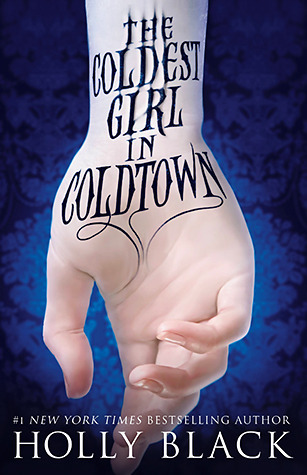
The Coldest Girl in Coldtown by Holly Black
You have to get over some chunky writing (lots of “seems to” and “tried to”). The dialogue is often interrupted with thoughts and actions, breaking the flow of conversation, like a not-well-edited movie. But if you can get past that (or you’re not as judgemental as I) then you could have a fun time with this. It’s one of the few vampire stories I’ve been able to finish.
Like others, it treats vampirism as a disease. A plague, more accurately, and those who’ve been struck with it have been sequestered to “coldtowns”–barricaded cities where vampires, humans, and ghouls eke out a quasi-symbiotic existence. As symbiotic as you can be when a lion’s trapped with the lamb.
But there are other interesting ideas too. Like how some vampires become online celebrities, cribbing from Lestat on how to live forever in an eternal party. But I’ve bounced off a Holly Black story before, and I think her writing style is just not to my taste. There is lots of thinking and repeated information. Feels like its aimed at a younger audience than me (which is 99% true for anything I read). Lots of “syntactic sugar” to make word count and impedes story efficiency. Just kinda confirmed my theory that this author is not for me.
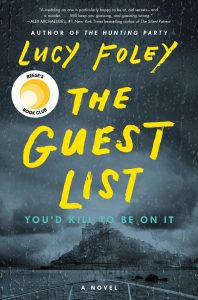
The Guest List by Lucy Foley
Murder occurs on a tiny Irish island in the middle of a wedding. The whole thing takes place over two days, but the murder doesn’t happen until the reception, chronologically speaking. Everything we get before that is all setup. Setup, setup, setup, that’s all that happens. It’s so boring that the author occsionally has to flash forward occasionally to when they find the body so you don’t get bored, so you don’t forget a murder happened. I ended up just speed reading through it. And it is eminently speed-readable.
The tagline–“You’d kill to be on it”–makes the book seem like something that it’s not. In fact, no one wants to be at this wedding, not even the bride and groom. Everyone hates or resents each other. They’d all rather be somewhere else. You’d think it’d be a mystery, a whodunit, but it’s not even a whydunit, because it doesn’t tell you the murdered or the murderer until the end. There’s no deduction, no clues. Just idiots being drunk and resenting their bad decisions and then wondering why there are consequences for their actions.
The thing about this book is that it’s just horrible people doing horrible things to each other. Some people like that kind of book–In Cold Blood, Gone Girl, anything by Bret Easton Ellis. Not me though. I like stories about good people trying to do the right thing. There are five POVs and the author doesn’t get into the pathologies of any of them. One’s a cutter, one’s a midlife crisis drunk, one’s a overachieving entrepreneur woman. They all act like character archetypes, not people, meaning they do exactly what you’d expect them to do. The boys are old boarding school chums and they have that “boys will be boys” mentality like in Adolescence. Is this toxic masculinity thing a big problem in the UK? I don’t see it much over here, but that might be because I’m in Minnesota. And I don’t leave my house.
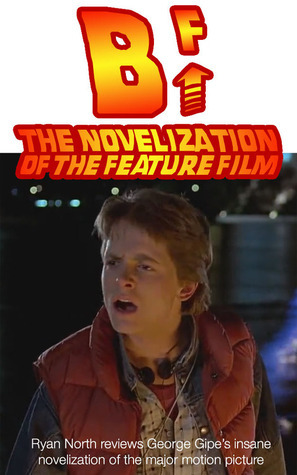
BF: The Novelization of the Feature Film by Ryan North
Somehow I landed on the TV Tropes page for novelizations and that led me down a rabbit hole to discover there are a lot more book adaptations of my core memories out there. More than just “Short Circuit“. As I read, I kept exclaiming “there’s a novelization of that?!” when I discovered there were books for *batteries not included, Santa Claus: The Movie, Howard the Duck, Ghostbusters, and more.
One in particular was Back to the Future, which had not only a novelization, but a novelization to the novelization. Specifically, Ryan North (author of those Dinosaur Comics and How to Take Over the World) converted a series of his Tumblr posts analyzing each page, into a book.
I like novelizations because it’s fun to see how “wrong” these things get when translated into a different medium, like Friday the 13th and Independence Day. You can’t communicate visual spectacle or long pauses of dread into a book. You can also sometimes get deleted scenes and changed material because they’re usually based around early script drafts.
Apparently, Back to the Future is a cut above the rest. It’s not just terribly written, but everything that made the movie great gets crapped on. Tight scenes get overwritten and overblown and lose everything that made the movie charming. Marty becomes sarcastic and snarky. Doc becomes eccentric and dull. When he finds out about the 1.21 gigawatts, he doesn’t sit in a chair, he goes to paint! It’s not something that was ever foreshadowed and it never comes again.
Gipe’s writing style is easy to make fun of because he writes like an old man, using archaic terms like “lout”, Marty being into “sound reproduction”, and “coldcock”. Not only did I get a refreshing blast of a classic movie, I got to see the MST3K treatment as well. Highly recommended.