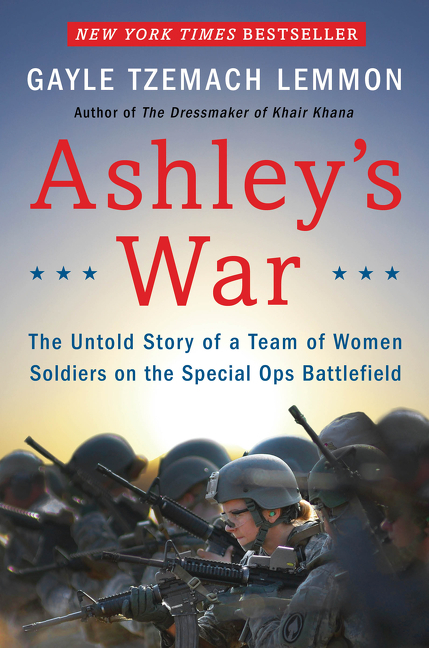
Ashley’s War: The Untold Story of a Team of Women Soldiers on the Special Ops Battlefield by Gayle Tzemach Lemmon
I’ve had this in my library for a long, long time, but never really had the inclination to read it until I was going to write a short story about an army woman in Afghanistan and needed research. I’ve already read “Love My Rifle More than You: Young and Female in the U.S. Army” by Kayla Williams, but I barely remember anything from that. That was a personal memoir and very anti-military. This is more of an ensemble cast or narrative non-fiction. A report on the first women integrated into Special Ops units.
Said Special Ops units were responsible for accompanying Black Ops squads to villages in Afghanistan and searching/interrogating for Taliban and weapons. Problem: the Middle East is a conservative, traditionalist region where culture has ingrained that women of the household must be deferential and subservient. That makes communication with men difficult, whether they’re their abusive husbands or hulking Americans with scary equipment all over them and loud voices. Enter the third gender–military women. Since they’re neither men nor native, they’re seen as something in-between. Someone that the Arabic women can trust and bond with, give access to places, and build relationships. And so begins the “Cultural Support Team” project.
It’s basically a story of the genesis of the program, starting with the higher-ups issuing executive orders, and profiling the various women who volunteered for the job. What struck me was how enthusiastic these women were. They loved serving in the military the same way a dog loves fetching a ball–unabashedly, warmly, and wholeheartedly. They love Black Hawk Down and strength-training and patriotism (even when their country doesn’t love them back).
I was surprised that it actually evoked some emotion in me. I don’t know why. Maybe because the writing doesn’t tell you how to feel–it’s academic, not prose. So, unlike fiction, which uses adjectives and adverbs the way movies use music to establish mood–to indicate what you should be feeling in that moment–allows you to feel however you will. You can read it as research or you can read it as a tale. It just describes what happened and how the characters reacted.
You learn a lot about women in the military but more as a sociological group than individuals. I would love to see a case study on one of these soldiers and their start-to-finish journey, working not as a gun-bunny but an ambassador.
Poor Things by Alisdair Gray
I really, really loved the movie. It’s a weird movie, but I loved it. What if Frankenstein was a manic pixie dream girl? It’s like a goth version of the Barbie movie.
This story is told in a mostly epistolary format, from the point of view of the wimpy black guy who’s the assistant to her father. Whereas the movie was very much about Bella taking charge of her life, asserting herself, her wants, and making sure they were met, the book is more about how “the boys” felt about all that. Since it’s from their perspective they talk about what they did at home while Bella was traveling the world and having lots of sex with Mark Ruffalo. The text spends more time with them than her, which is disappointing.
It gets more political than feminist, talking about world leaders and so forth. It’s not like Bella’s character is totally different from the movie–she definitely insists that her presence will not be ignored, but it’s missing Emma Stone’s charm. The movie is certainly superior, but the book won’t ruin your perception of it.
Coolest American Stories 2023 edited by Mark Wish
Hey, I finally found a pretty good collection of short stories. The foreword by the editor is weird–he gives a lot of history of previous editions that have no context to someone like me. And it makes it sound weird, like there’s a sordid soap opera history that I walked into accidentally.
But all the stories were good, all worth reading. I don’t think I skipped any of them, which I nearly always do. There are a few more editorial mistakes than there would be in a different book (in one story, “Sharleen” becomes “Sharlene”). But that doesn’t decrease the entertainment value much.
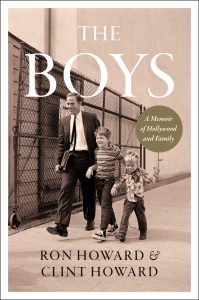
The Boys: A Memoir of Hollywood and Family by Ron & Clint Howard
No, this is not the Amazon Prime series about corrupt superheroes. This is the biography of Ron Howard and Clint Howard, two boys who have been in the Hollywood scene since they got out of diapers. If you’re my age, you should already know who these people are from the reruns on daytime TV you watched when you were sick from school. Ron Howard is the cute little red-haired boy from The Andy Griffith Show, then Happy Days, then became a director of good movies, like Splash, Cocoon, Willow, The Grinch, then great movies like Apollo 13, Cinderella Man, and A Beautiful Mind.
It was from my wife’s book club, and I picked it up intending to read just a sample, just to get a taste for what she’s reading. But damn, I just fell in love with their voices, the kindness of their parents, their family strength. This is not the kind of story you hear about from Hollywood. You hear about the Judy Garlands, the Debbie Reynoldses, the Faye Dunaways. How nice to finally read something positive and wholesome. About a family that loves each other and works together and loves acting. Not worrying about who was on cocaine and who was gay and who was having an affair. Not even megalomaniacalism or crazy parents.
Ron and Clint are good workers. They’re diligent, they love the craft, they know what they’re worth, and they’re not afraid to state so. They’re always boosting and supporting each other, putting each other in roles. It’s like one lifts someone on a pedestal, then use their station to a higher pedestal, like Chained Together.
It ends when Ron leaves Happy Days to become a director and Clint resolves his place in Hollywood as an actor. Which is kind of disappointing–I wanted more. I wanted to hear about Splash and Willow and A Beautiful Mind and raising Bryce and what it’s like to be a second generation in Hollywood, raising a third. And from Clint I wanted to hear about Ice Cream Man and voice acting and being a bad movie player akin to Bruce Campbell. He must have tons of stories from working on productions that range from ten to zero stars.
It’s not the typical story of a star, like Leonardo DiCaprio or Scarlett Johansen. It may not appeal to everyone if you’re not into the Hollywood scene. Me, I listen to old radio broadcasts like Screen Director’s Playhouse and The Red Skelton Show so I know a little about the people they’re talking about. The Howards are like an old stove or refrigerator that keeps working and working and working and never breaks. The Howards are here to show us how far you can go when you have stability and love and support. I have a new role model.
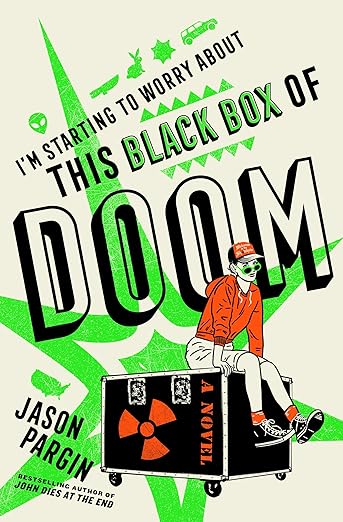
I’m Starting to Worry About This Black Box of Doom by Jason Pargin
First, I’ve got to say it’s pretty bold of Jason Pargin to write such a controversial book. And (just to remind myself) it’s “Par-jin”. Like gin you drink. Which he probably had to do a lot of.
The concept is simple to grasp. A young woman employs a young man to drive her and a big black box from California to Washington, D.C. But he can’t bring any cell phones or laptops or anything that could be tracked. And he can’t ask any questions about it or tell anyone where he’s going. And it has to be now.
Thematically, this book is about the difference between reality and the reality perceived through a lens. I think there must be a term for that. Maybe we haven’t invented it yet, but we will. It’s like Josh says in “The Blair Witch Project”. It explains why they keep filming even when they’re starving and lost and suffering.
"I see why you like this video camera so much. It’s not quite reality. It’s like a totally filtered reality. It’s like you can pretend everything’s not quite the way it is."Josh, "The Blair Witch Project"
But somehow, because people are nosy or have too much time on their hands, word gets out. And because no one’s saying anything, their imaginations run away with them, and with social media, it spreads. The whole thing is about how no one can do anything anymore without being farmed for engagement.
I love his writing because it’s always thought-provoking and darkly humorous. Why do we do this to ourselves? Why do we put stupid pictures on the Internet and farm for likes? Like they’re points, like there’s some place to trade them in after we die, like prizes in an arcade? It’s a thriller, but it’s also social commentary. The fact that the Internet has been a communication revolution and no one seems to care, and all they use it for is posting cat pictures. It’s become some kind of competition for engagement. What’s more, no one can leave anyone alone, no one can let anyone have any secrets, no one can disappear. A private life isn’t just hard to have, people wonder why you’d even want that.
The book seems to be an argument against the constant filming, against the “always on”, being like a Snow Crash “gargoyle”. But personally, I think the surveillance is better to have than not to. I mean, bodycams provide all kinds of evidence, no longer turning crimes into a “he said, she said” ordeal. They’ve uncovered loads of police corruption. England has CCTVs and when they premiered, people talked of Big Brother. But I didn’t hear any complaints anymore when they could see the guy who mugged you or track the rapist’s car.
Ask the American public if they want a wiretap and they’ll say ‘No.’ If you ask them do they want a feature on their phone that helps the FBI find their missing child, they’ll say, ‘Yes.’Lois Freeh
In any case, this is the best most fantastic thing I’ve read all year and I highly recommend it. Also it’s not science fiction, no matter what GoodReads says.