Vendetta by Peter David
(re-read)
This is one of my favorite books of all time. I’ve since fallen out of love with Star Trek, so I was anxious as to how I would respond as a forty-four-year-old. Nope, it’s still good. The great thing about Peter David is he was never afraid to go crazy, to do the awesome things the actual show couldn’t because of budget or it wasn’t mild enough. But here, we got a Ferengi borg, the Doomsday Machine from TOS, we got actual repercussions of Wolf 359, we got going to Warp 10, we got guest stars from previous episodes, we got a female Borg WAY before Seven of Nine was a thing, and we got space battles PLUS fisty-fights. It’s just as good as I remember it and I was sad for it to end.

The Troop by Nick Cutter
I had this on my to-read list, then my daughter read it, so I was prompted to move it up the queue. I love horror, but I don’t think I love horror books. Something about the medium. Maybe it’s the long form–drawing out events just doesn’t have the same visceral reaction for me. Maybe because I’m a male and I get more aroused by visual things. Not to say the book isn’t well-written. Cutter has a hard time with plot, but he does have a knack for sensory description. Stephen King says there are three levels of scary (from the top down): Terror, horror, and gross-out. Cutter nails the gross-out–that pool is full. The horror pool gets filled to about half, in my opinion.
But it’s horrible people doing horrible things to each other. There’s no one to root for. Everyone does dumb stuff and makes mistakes that lead to them dying in horrific ways and it’s like “Duh, didn’t you see that coming?” Some elements are either bizarre or a result of “didn’t do the research” or the author doing the research and then choosing to ignore it so his plot can work. The kids’ maturity seems to waver between eight and fourteen. They act pre-pubescent–they don’t know what sex is–but they know about sepsis. That or their troop leader is a dumbass… except he’s a doctor, so that’s out. I dunno. This might make a better movie than a book. It was the same thing with The Deep–sacrificing plot for scares.
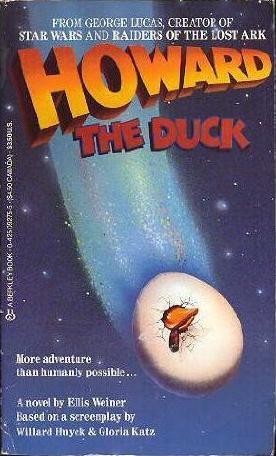
Howard the Duck by Ellis Weiner
The author of this book gets a gold medal for knowing not to take the material too seriously. First off, this is Howard the Duck (the comic). Second, it’s Howard the Duck (the movie). Third, it’s a novelization of Howard the Duck (the movie). It starts with an argument… between the two narrators. You know, the one who says “The cosmos… countless worlds upon worlds…” Yeah, the narrator of the book and the narrator of the movie start fighting. It’s a delight.
Ellis Weiner is trying very hard to be Hitchhiker’s Guide to the Galaxy. He doesn’t succeed, but I applaud him for aiming for the moon, but still being among the stars. No one’s going to reach Hitchhiker, much less with a Howard the Duck novelization. It follows the movie quite well and doesn’t add very much else except a heaping helping of duck puns. Like waaaaay more than you need. So many you will be sick of them by the end. But I think that’s the point. I wish it had cribbed more from the comic book (which I haven’t read yet). But I was pleasantly surprised. I got more than I expected out of this.

The House in the Cerulean Sea by T.J. Klune
This reached many “Best of” lists the year it came out. And it keeps appearing when I search for comps about a cozy fantasy book that doesn’t involve marriage and isn’t gothic. So I figured I should read it to see what all the fuss is about.
It’s very British. Very “what’s all this then?” The beginning is a long sequence involving The Company and Bureaucracy and Very High Management, like the Ministry of Magic in Harry Potter. He works in some kind of social work for children who sometimes have fantasy powers. And no one much bats an eye at that (this is not the X-Men). So he gets an assignment to a seaside home where there are six of them. One’s a devil, one’s a dwarf, one’s a mass of goo that wants to be a bellhop. It’s a motley crew of found family. But they have to stay at home or the townspeople will throw tomatoes at them.
It’s schmaltzy, but cute in a way. Like a stuffed toy. It reminded me of Miss Peregrine’s Home for Peculiar Children, but with less edge, more Disneyfied. The world doesn’t make much sense–computers exist but people only use typewriters and record players. The “racist” townspeople aren’t much of a threat–they have that soft British racism that’s more disdain and shutting the window. Come to America, we got real racism, like lynchings and cops who press on your neck for eight minutes.
It feels like this was written thirty years ago to teach lessons that were important thirty years ago (maybe that’s why the technology is so out of whack). They should be burning crosses on the lawn, not mildly insulting them at a record shop. It would make a good Disney+ series though.

The Norby Chronicles by Janet and Isaac Asimov
Years and years and years ago, I was in Boy Scouts. When you’re in Boy Scouts, you get a free subscription to Boys’ Life magazine. The magazine had a serialized comic of Isaac Asimov’s Norby the Robot. I never found out how it ended.
Isaac Asimov is famous for forming our collective idea of robots. The not-using-contractions, super-smart-but-unable-to-understand-social-cues kind. This book adds a little comedy/levity to those grim I, Robot stories. Our star is a young man in a space force academy. I guess Earth is fairly militant now, but in a good way? This young man buys a sassy robot from a junk shop. Said sassy robot turns out to have all kinds of powers, like flying, teleportation, and time travel. But no one knows how he does it. And then there’s dinosaurs.
Isaac Asimov did not write this book. His name is on the cover, but it’s obvious his wife Janet did all the work and it only got published because her husband’s name could be on the cover. I’m not even that much of an Asimov-phile and I can tell this has none of his insight or innovation. This is a children’s book for children of the fifties. The ones who were into Buck Rogers and Captain Billy’s Whiz Bang. The writing is like that too. The bad guy is a Ming the Merciless cult leader with as much relationship to the protagonist as the Care Bears had to Darkheart. There’s no character development. No one has a past or secrets or wants or needs. It’s just meaningless adventures in space with pirates and dragons and other things boys like.

The Women by Kristin Hannah
Seems a bit grandiose to just title your book “The Women”. Pretty presumptuous.
At first, the plot seems simple. A woman of high class, of “good breeding”, enlists in the Vietnam War because A) her brother did and B) she comes from a military family with a history of serving and C) it’ll help with her nursing degree. Problem: right after she enlists, her brother dies in combat, but she’s got to ship out anyway.
With the lack of nursing experience, she can’t get in the Air Force or Navy or Marines. She has to go with the Army. And being an army nurse is like MASH times ten. Dead bodies are everywhere, piling up in storage sheds, and more come every day. There’s dubious electricity, no one respects her, and everything is dark and explosions and Apocalypse Now. That’s about half the story.
The other half is when she gets out and has to deal with the fallout and PTSD and how no one is there to support her on return, not her family, not the homeland, not any other Americans because either they’re protesting or they don’t believe women served in Vietnam.
I wish I could give it five stars, but I can’t because one of the qualifiers of that rating is that I have to look forward to reading it every night. For this, the story was quality but it was “Oh boy, back to the world of Vietnam, when everything sucks and is miserable, but I guess it’s good for me so I can learn my lesson that I’ve learned fifty times already because the country still hasn’t healed from a trauma I wasn’t around for.” I mean, it is good, but it’s not breaking new ground. It’s both every war movie ever and every “female in the military” story like Private Benjamin and G.I. Jane. And I’m so tired of stories about Vietnam. It’s like when post-1999 social studies teachers said “No more papers about Columbine” because they were sick of reading about it.

Jim Henson’s The Dark Crystal: The Novelization by A.C.H. Smith
My goodness, this author likes to be detailed. I mean cleaning-the-wall-with-a-toothbrush detailed, so you can scrutinize every tiny embossed figure and glyph. This novelization breaks a lot of storytelling guidelines and not in a good way. It doesn’t start with action or anything interesting happening. There’s barely any dialogue. No tension anywhere. Long paragraphs of internal thinking and descriptions of setting. And, to my disappointment, little elaboration on the lore. I was hoping for some backstory on Jen, how he lived with the Mystics. Or what are the Skeksis exactly ruling here? But I got none of that. Even the illustrations aren’t very good–they’re just pencil sketches of caves. At least it was short.