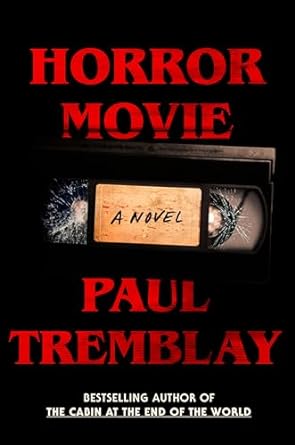
Horror Movie by Paul Tremblay
Paul Tremblay wrote The Cabin at the End of the World (Movie: Knock at the Cabin), which I liked and this kept popping up on my Amazon feed, and it seemed like it would hit all my buttons.
I’m impressed with his style. He doesn’t use any metaphors or similes like I do. The result of that, though, is that the book comes off as pretentious. It feels like a book the author wanted to be IMPORTANT. Like he wanted it to be taught in schools and have study guides written about it. And that means reading this is like deciphering a puzzle.
There are three timelines going at once. One is the present, as the narrator is working on a reboot of an old crappy horror movie he and his friends made a long time ago (a la The Evil Dead) that became an urban legend because stuff happened. That timeline is pretty normal, non-poetic. One is the filming of that movie from third person. And another is… like… the script of the movie? Or the internal of the main character as he becomes a monster? It’s hard to tell.
It’s trying to say something about cinema and entertainment and where monsters come from, but it has a hard time getting to it. The story sacrifices entertainment so it can deliver a message. My question is why can’t I just read an enjoyable story from beginning to end? I think you’d be better off reading The Last Final Girl by Stephen Graham Jones or The Final Girl Support Group by Grady Hendrix if you want something meta about horror movies.
Ferngully by Diana Young
So I’m not sure why–maybe it’s a response to all the short story collections I read last year–but I bought a bunch of old movie novelizations from movies in my childhood–The Dark Crystal, Ghostbusters, Gremlins, etc. I think I may have been inspired by BF: The Novelization of the Feature Film by Ryan North to find out how whack-a-doo these adaptations turned out to be.
You’ll be seeing more of them in the future. This one I got after I rewatched Ferngully for a live Free With Ads event (a podcast) and remembered it was book-based. I thought there must have been something missed that might cohesify this bare plot. Like, who is this Pips character(Christian Slater)? Is he supposed to be a romantic rival? A brother? Was he for merchandising? Where did Hexxus come from? What are the rules of magic here? If this takes place in Australia, where is everyone’s accent? How does that Big-Lipped Alligator Moment with the Tone Loc goanna translate into text?
It follows the movie pretty closely. Even Batty retains his frenetic and scatterbrained dialogue. But the plot is no less disjointed than the movie. There’s more world-building in the beginning, but also no conflict. New characters that don’t matter. Krysta has no clear goal or difficulties. It’s just twee fairies being twee and loving the forest and naming trees.
The movie has more emotional impact, maybe because the visuals and music help pump up what’s otherwise a lackluster plot. Unless you really really really like the movie, there’s no reason to read this. It feels like it was written because of the movie, not to inspire it.
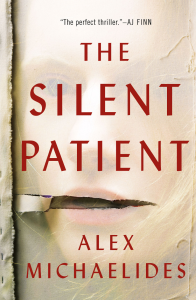
The Silent Patient by Alex Michaelides
This is a study in character. Not many events move the story forward. Two plotlines are going on–one is about a guy’s personal life, the other is about the girl (the title character) whom the guy is studying. And you don’t learn how they are related until the end (more on that later). It gives off Gone Girl vibes. Everyone is lying, reports contradict each other, you can’t tell if the husband is loving or controlling, if “the silent patient” is psycho or stable. And there are even diary entries. And there’s a big plot twist.
Now let’s talk about that. It’s not… well, it’s not unearned, but it feels like the whole book exists so that twist can come to life, not the other way around. Like a shaggy dog story or a set piece. Like the author started writing with the twist, then worked backward to flesh out the rest.
My thing about twists is that they’re usually pulled out of the ass. They occur without giving the reader any evidence or a chance to figure it out for themselves. Without this, the twist carries no weight. It’s either a coincidence or withheld knowledge. There’s nothing to suggest that Darth Vader is Luke’s father except for a few mysterious feelings.
The Usual Suspects is an example of a good use of the twist. You get to the ending and you think, “Oh, that’s why he said all those non-sequiturs.” The Prestige is so good I’m not even going to talk about it. IYKYK.
Midsommar is an example where it’s used badly. In the middle of the movie, the characters walk by a bear in a cage. No one’s around it. No one mentions it. No one refers to it. No one asks why it’s there. Just a bear in the shot, then we move on. The “twist” is that the bear’s skin is put on Florence Pugh’s bad boyfriend, then they paralyze him and set him on fire. Makes perfect sense.
But most of the time, twists are accomplished by omitting information the reader would have if they were in that character’s point of view. For example, the narrator being “dead all along”. Our POV character KNOWS he’s dead. He could let you know–there’s no reason not to–but he doesn’t. Because the author wants to manipulate your emotions. But all the author’s doing is not disclosing information you’d normally have if you really were in the POV of that character. Like how Aladdin says, “Ah, I never actually wished to get out of the cave. You did that on your own.” It doesn’t feel good if you’re the Genie.
Where the Crawdads Sing is another example of a twist done badly. There’s nothing to suggest Kya ever had a mindset to kill that guy. She doesn’t exhibit a violent streak. She doesn’t show how she values justice or capital punishment or revenge. She’s a passive doll throughout the entire story. The twist comes from nowhere. No clues were presented to make me believe the ending. I believe CinemaSins said it best…
Oh you honey-dipped whore of a twist! Telegraphed assface. You distractive Delilah dickhead of a movie! You Nell’s Eve’s Bayou Notebook motherfucker. You dirt-soaked, marsh-mashed, Carolina Reaper of bullshit! You Harlot of Humanity. You slut of story. You two-timing Tinseltown taint. Fucking lazy-ass bitch-ass manipulative horse-apple-sucking miscreants. You Charlie Brown Christmas of a movie. You extended SNL digital short parody. You ivory-dealing love-poaching, narrative-choking asshole!CinemaSins
The Sixth Sense is where it’s earned. And the reason it’s earned is because of how information or clues are presented to the audience. The beginning cuts away to the main storyline without any real resolution. The fact that Bruce Willis is in the next scene implies that he lived. Since we know stories, we think, “I guess Donnie Walhberg will be important later, I guess.” And he is, but not in the way we’re thinking. Every scene of Cole and his wife “interacting” is masterfully presented so that it works whether he’s present or not. “Ah, I never actually said he survived the gunshot. You assumed that on your own.”
The twist in The Silent Patient is like that, but comes as a result of how the story is structured. And the way the story is structured lets the author omit information you would otherwise have if you were in his shoes. It’s manipulation by medium, not by content.
If that would piss you off, don’t read this, because there’s not much here besides that. The book presents itself as a whydunit. Did she do it or didn’t she? Why is the therapist interested in her? But books are supposed to put you in someone else’s perspective, so you can escape and be someone else for a while. And if the author puts you in that driver’s seat without telling you the car is actually a truck, that’s not right.
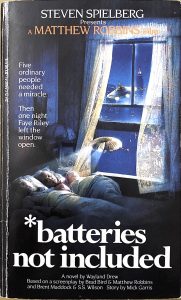
*Batteries Not Included by Wayland Drew
It’s a quick read. It humanizes the characters, gives them a little more depth and motivation for what they’re doing. Stuff you can’t get from a movie that has a limited perspective. With omniscience, you can get more background on how Frank saw the neighborhood change, what’s going through Faye’s mind as she has her episodes, Harry’s backstory, and so on. Makes them less archetypes. Doesn’t give any more insight into the robot aliens, which is what you might be looking for.
BTW this screenplay was written by Brad Bird? The Iron Giant and The Incredibles Brad Bird? What, was he twelve when he wrote this?
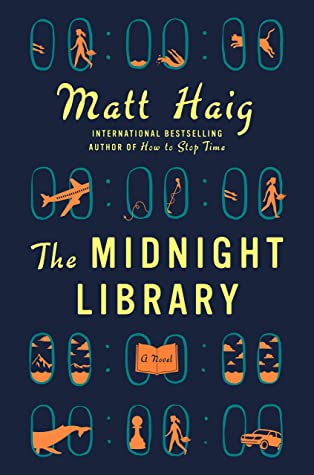
The Midnight Library by Matt Haig
I do not know why this was so popular. Maybe because it’s “safe”. It’s a story that we’ve all seen a hundred times before (the “Out-of-the-Bottle, Angel Subclass” story (e.g., It’s a Wonderful Life)), just with different branding. Like how Mighty Morphin’ Power Rangers were just Teenage Mutant Ninja Turtles with a different aesthetic. But it’s sooo stale and overused, because you get the same lesson time after time. Someone gets the chance to live a different life, then finds out the grass isn’t greener on the other side of the fence.
One review said it’s It’s a Wonderful Life meets Where’d You Go, Bernadette?, which I goggled at, because those are two tastes that do not go together. Bernadette is about a big city artist who can’t fit in with the suburban housemoms, and then has quirky adventures.
The Midnight Library is about a depressed British girl who has no life. She gives up her dreams of being in a rock band or going to Australia or getting married and so on, and commits suicide. Except she goes to an in-between place where every book is her life if she’d done something different. Like the multiverse in a Kindle. Since she complains about how unsatisfying her previous life was, she’s allowed to choose a different one, if she can find one she likes.
The problem is A) it is REPETITIVE. Girl opens a book, does a few things, is disappointed, goes back and opens a different one, repeat. That is ALL this book is. B) You know exactly how it’s going to end before it begins. It looks like it might be interesting/different when she meets another “slider”, like is there a “Wonderful Life” multiverse? But it’s immediately dropped.
Here’s the problem with this kind of story (and it happens every time): the “game” is unfair. Why? Because all the conflict comes from the fact that the protagonist DOES NOT KNOW what’s going on in this new life. George Bailey, Alf, Shrek, Richie Rich, Nicholas Cage, Ashton Kutcher, Santa Clause, Spider-Man, Kermit, Elmo, Harry Potter, various Simpsons, the Teenage Mutant Ninja Turtles, Buster Bunny, a few X-Men, Angel, Green Arrow, the friends of Friends, Al Bundy, Captain Picard, Supergirl, Xena, Batman, Garfield, Morty of Rick & Morty, they’ve all gone through this. And the difficulty comes from the fact that they aren’t familiar with what’s going on. If they had been living this life from the beginning, as they would have been, they wouldn’t be stymied by not knowing the characters or settings or situations in this new life.
You can’t just plop a person in the middle of a situation with no debriefing and expect them to make a fair judgment. The conflict is that she doesn’t know who Ed and Joe are, or what to say for this speech she’s about to present, or where this concert she’s suddenly giving is. If the “game” was truly fair, she’d have the applied knowledge of that life. She’d know what to say for that speech because she’d done it so often. She’d know her setlist so she wouldn’t be caught with stage fright.
And because the game’s not fair, the protagonist always rejects the life because it doesn’t fit in with her values. Well, of course it won’t because her values were built from her previous life, not the one she’s trying to go to. In this book, it’s especially perfidious because it’s always because someone she knows has died. But if she were really in that life, she would have already healed from that emotional wound, gotten used to that loss. You’re creating conflict where there doesn’t have to be because the narrator is a dick, giving them a hard situation for no reason.
Also, this book showcases a dead cat. Really, it’s two dead cats, but they are really the same cat.
Gremlins by George Gipe
It might be common knowledge for any fellow Internet junkies, but the novelization of Gremlins takes some “liberties” with the source material. For example, George Gipe decided that the mogwais are from space and were genetically engineered (years before Jurassic Park made that a thing) by an alien named Mogturman. And I guess they were supposed to do something like terraforming? It’s not clear, but none of this makes a difference in the story.
What I didn’t know was that the mogwais/gremlins talk to each other. They have some kind of telepathy thing going on. Stripe actually has a conversation with Gizmo. I mean, it’s not a good conversation (good as in well-written). They talk like robots or stiff Klingons. It does not match their behavior or the tone of the story.
It’s the same author of the Back to the Future novelization featured in BF: The Novelization of the Feature Film, so you know there’s going to be some tone shifts and pacing issues. The gremlins don’t hatch until halfway through the book, so you can see Mr. Gipe had word count on his mind.
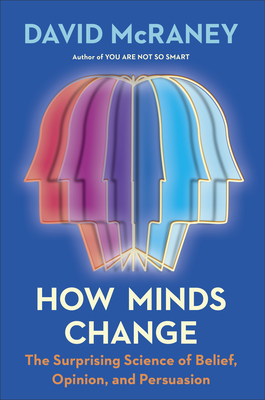
When Minds Change: The Surprising Science of Belief, Opinion, and Persuasion by David McRaney
I don’t need to know how we got here, how things got this bad, how Trump got elected a second time. The past is written and it’s etched in stone. What I need to know is how to change it. And that means changing the minds of other people. This book is asking the same thing, and it has answers.
Yes, there are cases where those conspiracy theory nutjobs on YouTube and TikTok actually changed their minds about something when presented with evidence. How did that happen? Can it happen again? How can we use this power for good?
It all comes down to something called “deep canvassing”. You might have heard about it (or something similar) on an NPR podcast. To sum up, it’s basically having a mini-therapy session with the person whose POV you want to change. You don’t thrust any arguments on them, you make them re-examine their own beliefs and if their life experience matches up. Figure out why they feel the way they do.
Because the MAGAs are right–facts don’t care about your feelings. But feelings don’t care about facts. You can give someone all the evidence in the world, they’ll bring up counterevidence like a hydra (cut off one head, two more appear). The active ingredient is in not letting the victim ruminate on what they’re receiving. No time to digest, only acceptance. The mini-therapy gives them that time.
It won’t change everyone’s minds. I think the book said that, in one state, it only caused a 3% shift in the opinion polls. That sounds like nothing, but according to poli sci heads, that’s a tremendous difference. So there is hope to deprogramming these morons, if we can get them away from Fox News. If you need to learn how to do it, this is the book for you.