So I just finished revising two novels back-to-back. That’s a lot of revising. That takes its toll. Not that I prefer one over the other (composing vs. revising), but if you do one or the other for a long time, it grinds. In any case, I needed a break from writing without taking a break from writing. I didn’t want to write any new short stories, didn’t want to start a third novel. If only there were something fun to do with my writing time. Something to remind me why I love it, like a game. A game with writing. Not one where you just fill in blanks like a mad-lib. And then I remembered that solo RPGs exist.
One could view solo RPGs as something only the most losery of losers do. Those who can’t even get enough friends to play D&D. They don’t even get the fun part–the player interaction and collaborative storytelling. Or you could view them as writing with no purpose. Like, you can’t publish… whatever you produce from solo RPGs. (I don’t know how they work–do you move tokens around? Are there cards like a community chest?). In Good Game, No Rematch, which I recently read, the author spotlighted three: Thousand-Year-Old Vampire, Quill, and Star Trek: Captain’s Log. So I thought to start with those.

Thousand-Year-Old Vampire
The first trick was figuring out how to get a solo RPG. This was the first one I searched for and I couldn’t tell what bits I needed. Was it free? Was it Creative Commons? Was I being suckered if I had bought it from a place? Could I get a digital copy or should I paper-and-pencil it? Digital would be preferred since I write on my computer. Fortunately, all three were available on DriveThruRPG, so I bit the bullet and opened my wallet.
So, how this game is played is that you pretend you are a vampire, probably in the Middle Ages. You start with a prompt saying how you became a vampire. Then you roll a D10 and a D6. Subtract one from the other and that’s how many prompts you move forward (or backward, if it’s negative). There are about a hundred and each has three options. So you are never lacking for things to write about. Each prompt is an event in your life, but you can only “hold” so much in your head. So as you gain memories, you “lose” others. (You can’t expect a thousand-year-old to recall everything.)

Your character also has four “inventory” mechanics: skills, resources, characters, and marks. Usually, the prompts will involve one of these, as in lose one, gain one, change one, and so on. If you ever have no skills and resources, you lose/die. But the game ends with you dying anyway, once you get to the later prompts.
My review? This one isn’t too bad. I’m glad I started with it, because it has the most writing-oriented gameplay with a nice smattering of mechanics. The prompts are good and thought-out. You start with a little story and end up with a big story. I said you couldn’t use any of these for publication, but this might have given me an idea for a short story. For fun, I’ll post what I produced below. I would play this again, though I imagine the beginning would start to wear thin, since you always start in the same spot, like a visual novel.
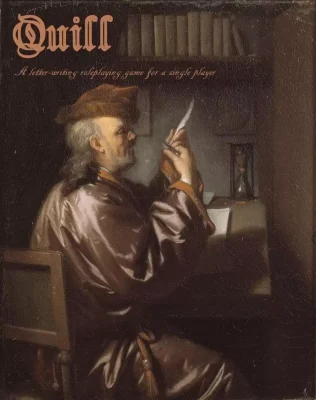
Quill
This one I wasn’t as impressed with. I knew it was about writing letters, but both the aesthetics and the game mechanics are a little thin. First, you choose a “class”, something like a monk, a peasant, an aristocrat, or a performer. But that’s about it–you don’t generate a name or backstory or friends, enemies, skills, resources, or anything like that. All a class does is influence a few stats.
And what are those stats? There are only three: Penmanship, Language, and Heart. And each only scales from 1-3. That number is how many d6 you will roll. A 5 or 6 is success, so the more dice you roll, the better your chances. But what are you trying to succeed at?
The game book comes with four scenarios. In each scenario, your objective is to write a five-paragraph letter to some purpose, informing or persuading or what-have-you. You get points by rolling dice at certain points during the writing.
After each paragraph, you roll Penmanship and get a point on success. Each scenario has a list of word pairs. One is a dull word and one is a fancy word. When you get to a point where you have to/want to use one of those words, you roll Language. If you succeed, you can use the fancy word and get one point. If not, you use the dull word and get no points. And you only get one per paragraph.
But if you want, you can modify the word with an adjective if you succeed with Heart. Before rolling Language, you roll Heart to see if you can even add a modifier or not. If you do and you get the fancy word, you get 2 points. But if you get the dull word, you get -1 point. So Heart is like going “all-out” where you take a risk for more points. But if you fail, you get less than if you hadn’t tried at all.

My issue is that the dice rolling interrupts the writing process. I found I had to consciously engineer my sentences so I could fit words from the list, then stop and roll the dice. It disrupted the flow-state. It was like a school assignment where you have to use a vocabulary word in a sentence.
When your letter is done, you add up the points and consult the “results” of the scenario to tell you what effect your letter had. A low score means your letter probably offended someone or failed to get what you wanted. A high score means they loved your letter and the consequences turned out even better than you expected.
It seemed impossible to score high. My class was Monk, so I had high Penmanship, but moderate Language, and low Heart. That meant I seldom succeeded in adding an adjective and could only use a fancy word half the time. My only consistent points came from Penmanship, and you can’t gain more than 5 from that (one per paragraph). So I always ended up getting the second-to-worst result.
But also, what you write doesn’t have any consequence on the game. In Thousand-Year-Old Vampire, there is no “winning”, but you do end up with an interesting story. The challenge is how you answer the prompts, especially utilizing the skills and resources you have. But in Quill, there is no story/campaign. You don’t have a character, just an occupation/archetype. Each scenario’s result is 100% based on luck and has nothing to do with what you wrote. You might as well just play Craps.
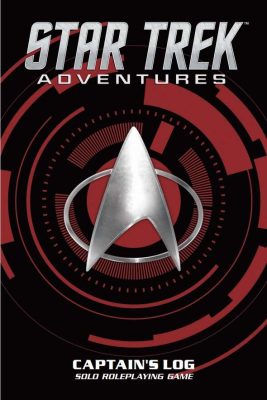
Star Trek: Captain’s Log
Captain’s Log is the antithesis of Quill. It’s got a LOT of backstory and background. Too much. It’s a 300-page book, which is closer to a traditional RPG. I know the Star Trek universe pretty well, especially the TNG era, so I wasn’t overwhelmed. But what bothered me is that it didn’t have to be 300 pages.
So much of it is fluff. Nearly every paragraph contains rhetoric as if it’s still trying to market the game to you. Every section concludes with something like “Will you be a scientific Bajoran meeting space parasites or a stoic Klingon wrangling tribbles in the Rigel system?”
The first half is all about Star Trek, both in-game and out. The history of the universe, the philosophy of Star Trek, society, technology, what’s a yellow alert, what’s a prime directive, etc. None of it is about how to play the game. Took me days just to get through the lore.
When you do get to the game, it’s complex. Which is fine, I like learning new game rules. But it takes a long time for the book to explain what each thing is. There’s traits, attributes, disciplines, focuses, and values. And no intuitive way to tell which is which. Are the traits point-based or the values? What’s a focus and what’s a discipline? What’s innate to my species and what do I choose? I think I got overwhelmed there, because each option is carefully broken down and cross-referenced by potential scenarios and roles (engineer, medical, captain, etc.), describing how each would react in such-and-such problem (physical problem, emotional, social, etc.) Even your starship has traits you can roll on.
I guess more information is better than less, but at this point, I still don’t know how to play. And I’m starting to not be interested anymore. Either I’m getting resentful that the book won’t just get to the point or some context as to how this all fits into the game, or I’m bored.
The gameplay is essentially a mission. Each mission has 15 scenes: five for the first act, five for the second act, and five for the third act. Each scene is progress towards finishing that mission. You roll a D20 and consult various tables for mission type, the inciting incident, the theme, any advantages or complications, the NPCs, the locations, and other details. And then… THEN you do something, starting with writing a “captain’s log”, just like in the show. State what you’re doing and why you’re there and maybe your feelings about it. Then it tells you to narrate the opening scene. You have to imagine what task you would do to start the mission. You do some more rolling, you imagine how your character would react based on that, roll again, consult a table, and so on. Maybe your values are challenged, maybe you get into combat, which is its whole thing. Repeat until the mission is finished.
This book is trying to trick you into writing a Star Trek script.
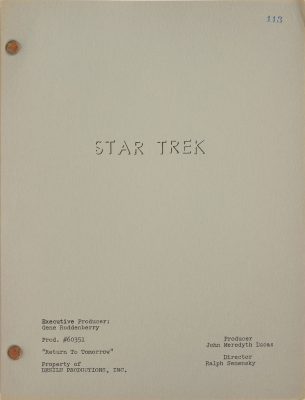
It even talks about storytelling elements like “in media res” and “flashbacks”. All these tables, all you’re doing is dumping out a whole bunch of Lego pieces on the ground. You have to figure out how they all fit together. That’s not storytelling, that’s construction. And you can’t make things flow from one thing to another if you’re restricted on pieces to work with. That’s how you get set pieces that don’t fit into the story (like the fist-fight in Bridget Jones’s Diary, Hancock being two different stories, and the dune buggy chase in… Star Trek: Nemesis) It took two days to make my character, partially because I felt so uninspired. Star Trek is a utopia and the game doesn’t encourage you to make a conflicted character. They want you to make a skilled worker.
But I muddled through that and made a Bajoran who grew up under Cardassian occupation, but on a remote colony where both sides got along, like the Romans and Jews in Ben-Hur. He was a civilian skilled in subspace communication, stationed on a starbase close to the frontier. It looked like a good start, but then it all fell apart when I tried to start playing.

I rolled a dual mission type–near-space exploration and patrol. That made sense–I could have it so that my guy was accompanying a patrol ship, checking in on satellites and ansibles. Then I rolled Incident: Arrest and Theme: Colony. Okay, um… not sure where there’s colonies around here. Or why a communications specialist would be involved in an arrest. And the Advantage was Redundant Systems – a little-used piece of technology or biology helps ease the situation. Okay… how should a backup hard drive ease someone’s arrest (whoever it is)? Then I rolled Encounter: Deep space. I thought I was in near space. How is that supposed to work? And then wormhole that crosses light years in an instant. Wait, I thought the theme of this was supposed to be an arrest on a colony. How do I join these two together? And then Spacefaring Civilization: a vessel capable of firing while cloaked is attacking supply lines. Wait, now we’ve got interstellar conflict? I thought this was supposed to be about arresting a colonizer. How do I fit together a small-scope personal story and a large-scope war story? Then I rolled an NPC: survivor from a shipyard. Huh? Now there’s a shipyard? Where? What did he survive? I thought it was supposed to be a matter of arrest, not survival.
And at this point, I just gave up. Not only was I tired of reading page after page of rhetoric, but when it got to the gameplay, all I had was random junk I had no idea what to do with. I mean, if I spent the time, I’m sure I could cobble a way to fit these all together–a wormhole and an arrest and a cloaked vessel and a shipyard and me, a communications officer. But that would take the time and effort I reserve for publishable work. I’m not going to spend that on a game, which by definition is supposed to be fun and easy. And what would I have when I was done? Anything coherent? I doubt it. Certainly not a Star Trek episode. No, thank you. I’m done.
Conclusion
So yeah, like the stats in Quill, I got one I liked, one I didn’t, and one I was middling on. But I didn’t get soured on solo RPGs. I think I had a good experience. When you’re trying a new medium, part of the battle is learning what you like and what you don’t like, like how a sculptor might eschew papier-mache but gravitate toward ceramics.
It must have done something to me because I keep thinking about doing another one. I wasn’t super-thrilled with Quill, but it has an add-on themed around Lovecraft Mythos. I’ve always wanted to learn how to write that kind of stuff. Plus, Instagram has been giving me suggestions (advertisements) that look interesting. If you were to bet on this being my last foray into solo gaming, I think you would lose.




One Comment
Scott
Nice article and it’s always great to see people getting into solo rpgs. I’m disappointed you were disappointed in Quill, but I understand. I wrote it in 2016, before the vast majority of modern solo rpgs existed, so there wasn’t much of a template to work from. Maybe English Eerie may be more up your alley, since I designed that to be much more of an immersive journalling game.